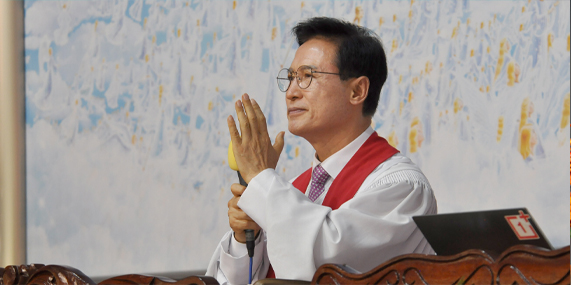
Secret to Remaining Unshaken Even When Crisis Strikes
Bible passage: Matthew 7:24-27
“24. "Therefore everyone who hears these words of mine and puts them into practice is like a wise man who built his house on the rock. 25. The rain came down, the streams rose, and the winds blew and beat against that house; yet it did not fall, because it had its foundation on the rock. 26. But everyone who hears these words of mine and does not put them into practice is like a foolish man who built his house on sand. 27. The rain came down, the streams rose, and the winds blew and beat against that house, and it fell with a great crash."
There is a book titled ‘Rip Power’. The term ‘Rip’ means “to tear apart” or “to rip up.” It’s an expression used when something needs to be completely changed anew. The author’s main point in ‘Rip Power’ is as follows: When we want to renew or change something, we often hear that we must first change our thinking. For example, "If you think positively every day, your life will become happy," or "If you want to be rich, you must first believe you can become rich." We often hear that to achieve something, the first step is to change our mindset.
However, this book argues otherwise. While changing one's thoughts is important, it insists that merely shifting to positive thinking is not enough to change one’s life. So, what should we change to truly transform our lives? It’s not just our thoughts that need to change, but our actions, based on those transformed thoughts. If we want to completely renew and change our lives, we must change our actions. Today’s scripture is part of the famous ‘Sermon on the Mountain’. This sermon, found in Matthew Chapters 5 to 7, is Jesus’s most renowned teaching, delivered on a mountaintop. In the Sermon on the Mountain, Jesus gathered essential teachings that believers must practice, comprising three chapters. And today’s scripture is the conclusion of this Sermon on the Mountain.
If we were to summarize the entire Bible, it would be Matthew Chapters 5 to 7, the Sermon on the Mountain. And if we were to further summarize the Sermon on the Mountain, it would be today's scripture, Matthew 7:24-27. And if we were to condense it even further, it would be verses 24 to 25 of today’s scripture.
They say, [24] Therefore everyone who hears these words of Mine and puts them into practice is like a wise man who built his house on the rock. [25] The rain came down, the streams rose, and the winds blew and beat against that house; yet it did not fall, because it had its foundation on the rock. Because these two verses serve as the purpose and conclusion of the lengthy message in Matthew Chapters 5 to 7, I would like to share today’s message under the title, "Secret to Remaining Unshaken Even When Crisis Strikes," that is, “even if rain falls and the wind blows against the house.”
1. To remain unshaken in times of crisis, we must act, not just think.
William James, the American psychologist known as the founder of modern psychology, once made a profound statement: "We don't laugh because we are happy; we are happy because we laugh." When we say, "Oh, I have nothing to laugh about; my life is just the same old thing," life becomes even duller, and we feel more withdrawn, creating fewer reasons to laugh. However, even if you don’t feel like laughing, if you look in the mirror and force yourself to smile, you may find that laughter changes you and brings happiness into your life.
Psychologists argue that laughter comes first, followed by happiness. The author gives this example: if you want to develop a particular character trait, act as if you already possess that trait. For instance, someone who is introverted yet admires people with extroverted personalities should not just think about it but should act like an extroverted person. For example, when meeting a new church member or someone returning after a long time, some people, being shy, struggle even to say hello and are reserved.
Others, however, greet new people with smiles, shake hands, embrace warmly, and welcome them with open arms. If you find this pleasant to witness, then do likewise. The book’s main point is that actions influence thoughts and personality. If you want to be cheerful, the first secret to becoming cheerful is to act like a cheerful person. No reason to laugh? Then laugh even more. If you are exhausted and weary, instead of remaining downcast, say a louder "Amen," laugh, and participate actively in worship. Worshiping half-heartedly can make you feel even more weary, leaving you wondering if you received any grace or not.
As this book suggests, those who wish to change must change their actions. In today’s scripture, Jesus emphasizes that action is essential for those who want to be unshaken even in times of crisis. Verse 24 says, “Therefore everyone who hears these words of Mine and puts them into practice is like a wise man who built his house on the rock.” Verse 26 says, “But everyone who hears these words of Mine and does not put them into practice is like a foolish man who built his house on sand.” However, despite reading the Bible and listening to God’s Word in worship, we often find that we remain unchanged and that our lives don’t transform. Here, we must clarify why we read the Bible and listen to God’s Word. We don’t read the Bible to satisfy intellectual curiosity.
We read it to transform. Why do we listen to sermons? We listen to and understand God’s Word of truth so that we might live according to His will. How has the Word you have read or heard brought about change in you or altered your life? Why don’t our characters change, and why don’t our lives transform? The reason is that, while we hear and read God’s Word, we do not put it into action. Nike’s slogan, ‘Just do it,’ is simple but famous, implying "You can do it." In this sense, we, too, need a ‘Just do it’ mindset. For example, when reading Matthew Chapter 5 and coming across verse 44, which says, "Love your enemies and pray for those who persecute you," don’t just gloss over it but immediately think of someone you have had a strained relationship with and call them. “Hello, this is [Your Name].
I wanted to apologize. I was reading the Bible, and the words ‘love your enemies’ made me think of calling you. I don’t mean you are an enemy, but I think it would be nice to get along better. Let’s keep in touch.” Then hang up and continue reading the Bible. If you reach Matthew 6:20-21, where it says, “Store up for yourselves treasures in heaven,…………for where your treasure is, there your heart will be,” you should make a resolution. For instance, “Our church is undergoing a building project, and I should contribute. I said ‘Amen’ to the idea of storing treasures in heaven, so I will make a meaningful donation for this project.” When you read Matthew 7:1-3, which says, "Do not judge others," reflect on how much you may have spoken, judged, and criticized others without sound evidence. Then find that person and say, “I’m sorry. I was too proud. From now on, I’ll pray for you.”
This is how you act on the Word you have read. This is what Jesus is teaching in today’s scripture: we must not only hear but also do. This is the secret to remaining unshaken in times of crisis, as emphasized in the book ‘Rip Power’. There’s an interesting verse about Moses and the Israelites crossing the Red Sea. When Moses cried out to God, God said in Exodus 14:15, "Why are you crying out to me? Tell the Israelites to move on." This might seem confusing if read hastily, as though God were discouraging prayer. But it actually means, “Why do you only cry out to me?” God isn’t saying not to pray but to take action after praying and move forward in faith toward the Red Sea. James 2:22 says, “You see that his faith and his actions were working together, and his faith was made complete by what he did.” In Korea, a church elder’s son went to the U.S. for studies.
This son, relying on his wealthy father, used language studies as an excuse to go for fun. The father, knowing this, gave him a Bible instead of money and said: “Whenever you face difficulties, rely on God, pray, and read this Bible. You will find answers.” The son, instead of praying or reading the Bible, kept writing letters, asking for more money. But the father kept replying, "Read Isaiah," or "Read Matthew." The son, thinking reading the Bible wouldn’t bring money, grumbled until one day he reluctantly decided to read Isaiah. He opened the Book and found a cheque inside. He opened Matthew and found another cheque. James also had a cheque. The father had placed these cheques in the Bible so his son could experience blessings through reading the Word, rather than just handing him cash. The son then understood his father’s intentions, and he became a good son who prayed, read the Bible, and lived according to God’s Word.
2. To remain unshaken in times of crisis, seek God’s will before acting.
Reading Matthew 7:24 with a different emphasis, it says, "Everyone who hears these words of Mine and puts them into practice.” While it emphasizes action, it first says to “hear” before acting. In Greek, “to hear” is akouo, meaning “to understand and obey.” Hebrews 2:1 says, “We must pay the most careful attention, therefore, to what we have heard, so that we do not drift away.” Jesus shared the precious teachings of the Sermon on the Mountain, and we should not simply listen and let them pass by. Instead, let these words transform your character, set a standard for your life, and bring power and change. Embrace and understand them deeply.
Matthew 7:21 says, “Not everyone who says to Me, ‘Lord, Lord,’ will enter the kingdom of heaven, but only the one who does the will of My Father who is in heaven.” Simply saying “Lord, Lord” is not enough to enter the kingdom of heaven. A faith that leads to heaven requires action, specifically actions aligned with the Father’s will. So, before acting, we need to know the Father’s will. Listening to God’s word is not just about hearing it but about discerning His will. Knowing God’s will means understanding what He wants us to do. We should ask God, “What should I do?” This way, our actions will align with His will, and His Word will guide us on the right path, leading us to a life of truth. In the Book of Acts, we read of Paul’s transformation when he met Jesus on the road to Damascus while on his way to capture believers. Acts 22:6-7 says, "About noon, as I came near Damascus, suddenly a bright light from heaven flashed around me.
I fell to the ground and heard a voice say to me, 'Saul, Saul, why do you persecute me?'" Paul, who persecuted Christians, encountered Jesus, leading to a pivotal moment in his life. Paul then asked two questions. Verse 8 says, “Who are you, Lord?” Jesus identified Himself as “Jesus of Nazareth, whom you are persecuting.” Then, in verse 10, Paul asked again: "What shall I do, Lord?" On the road to Damascus, Paul’s first question was, “Who are you, Lord?” He was establishing his relationship with Jesus, asking if Jesus truly was his Lord. Paul didn’t stop there; he then asked, “Lord, what shall I do?” Why did he feel the need to ask, “What shall I do?” Paul was likely overwhelmed with regret because, up to that point, he believed that capturing Christians was the right thing to do based on his beliefs and conscience. However, meeting Jesus revealed that his actions were not for God but were against Jesus Himself. Similarly, church leaders may work tirelessly for the church and their flock, but if, upon meeting the Lord, they hear Him say, “That was for your self-interest, not true devotion for souls,” how great would their disappointment be?
If workers in the church serve with zeal, only to find out from Jesus that their actions were for personal recognition and not out of genuine service to others, that revelation would be heartbreaking. Likewise, if church members believe they have faithfully lived their faith but then hear Jesus say, “Your faith was not a true love for Me, but a lukewarm, superficial faith,” how great would the shame be? Only a humble heart before God asks such questions. We should always ask the Lord, “What shall I do?” We should ask this daily, weekly, and whenever facing challenges. “Lord, how can I fulfill my calling well? What should I do to bring joy to God?” By asking these questions, we ensure that we are not following our will, but rather God’s will, and in doing so, we avoid mistakes and receive blessings.
After meeting Jesus on the road to Damascus, Paul dedicated his life to God’s will, saying in Romans 14:8: "If we live, we live for the Lord; and if we die, we die for the Lord. So, whether we live or die, we belong to the Lord." To understand God’s will, we must read the Bible and listen to sermons during worship as spiritual nourishment. In one church, there was a 62-year-old woman who had believed in Jesus for 50 years and read the Bible. However, she had only read Genesis and Exodus because she kept starting but never finishing the Bible. How can a church grow if the members don’t read the Bible? We must study the Bible to know God’s will. Only those who know God’s will can remain unshaken in times of crisis. In Matthew 7:24-25, the difference between the house built on rock and the one on sand may not be obvious in normal times. The house on sand may even look more appealing.
However, when a life crisis or significant challenge arises, the difference between the two becomes clear. Verse 25 says, “The rain came down, the streams rose, and the winds blew and beat against that house; yet it did not fall, because it had its foundation on the rock.” Verse 27 says, “The rain came down, the streams rose, and the winds blew and beat against that house, and it fell with a great crash." Reading the Bible and knowing God’s will does not guarantee a life free of storms, but it does provide a solid foundation. Those who hear and act on God’s Word, like a house built on rock, can withstand life’s floods and winds without falling. A pastor I know shared that his father, also a pastor, passed away during an extended fast when he was young. This tragedy struck his family suddenly, leaving them feeling lost. However, the power of God’s Word sustained them through that storm.
His mother had read the Bible thousands of times and copied it by hand eleven times. She could recite the entire Bible from memory. Each time Satan attacked, she had scripture to counter it, and with the Word as her defense, Satan could no longer harm them. Though floods and storms struck their household, they did not fall because they were a family that lived by the Word. As a result, all the children grew up to be remarkable individuals, with this pastor leading a prominent church in Korea. Israel is currently at war with Hamas, an armed Palestinian faction.
As a small nation, Israel is defending its territory from Hamas's rocket attacks by operating a comprehensive, mobile air defense system called the Iron Dome. The Iron Dome allows Israel to protect its citizens and succeed in war by intercepting and neutralizing the rockets launched by Hamas or Hezbollah, even if those rockets are supplied by countries like Iran or North Korea. No matter how many missiles are fired, the Iron Dome blocks them all. So, how can an effective attack be made under such circumstances? Spiritually, the book of Ephesians describes how the evil enemy, Satan, constantly fires flaming arrows.
Ephesians 6:16 says, “In addition to all this, take up the shield of faith, with which you can extinguish all the flaming arrows of the evil one.” No matter how many flaming arrows the enemy fires, they can all be blocked with the shield of faith. Verse 17 also instructs believers to put on the helmet of salvation and be equipped with the sword of the Spirit, which is the Word of God. It says, “Take the helmet of salvation and the sword of the Spirit, which is the word of God.” Just as Israel has built the Iron Dome defense system, we, too, must equip ourselves by reading the Bible, fortifying ourselves with God's Word, and holding firmly to the shield of faith through prayer. May you repel every attack from the enemy, blocking each assault with the corresponding Word of God and extinguishing every falsehood and scheme with the shield of faith. Therefore, when unexpected floods and winds strike in life, bringing crises that shake us, may you stand firm, overcome every challenge, and emerge victorious each day.
3. To remain unshaken in times of crisis, we must rely on the help of the Holy Spirit, our Advocate.
Today’s scripture is part of the Sermon on the Mountain, where Jesus summarized the central themes of the Bible. It’s as if He shared the entire Scriptures in condensed form. For those who haven’t read the Bible in its entirety, I encourage you to read Matthew Chapters 5 to 7 ten or twenty times. Practicing the teachings within these chapters alone can bring immense grace and abundant blessings. Jesus concludes today’s message by saying, “Everyone who hears and acts on these words is like a wise man who built his house on the rock.” Unfortunately, the disciples heard the teachings but failed to act on them, and when Jesus was crucified, they scattered like those who had built their houses on sand. Later, in Acts, we see Jesus, after His resurrection, giving His disciples a final instruction before His ascension.
Acts 1:4 says, “Do not leave Jerusalem, but wait for the gift My Father promised, which you have heard Me speak about.” From 1 Corinthians 15:4-6, we can estimate that about 600 people witnessed Jesus’s resurrection. It says, “that He was buried, that He was raised on the third day according to the Scriptures, and that He appeared to Cephas, and then to the Twelve. After that, He appeared to more than five hundred of the brothers and sisters at the same time……” Jesus instructed those 600 people to remain in Jerusalem, gather in the upper room, and pray, awaiting the Holy Spirit promised by the Father. However, only 120 of them followed Jesus’s words, gathering to pray in the upper room, while 480 others dispersed. Acts 1:15 says, “In those days Peter stood up among the believers (a group numbering about a hundred and twenty).” Even though Jesus Himself had given the instruction, not everyone acted on His words. Similarly, many people listen to today’s sermons but do not put them into practice.
I see this in attendance at prayer meetings; although I encourage everyone to pray and participate, the numbers remain the same. Many may have the desire to come, but the spirit is willing, and the flesh is weak. Before the crucifixion, when Jesus prayed at Gethsemane, He told His disciples three times to “watch and pray,” yet they continued to sleep. Jesus remarked, “The spirit is willing, but the flesh is weak.” Mark 14:38 says, “Watch and pray so that you will not fall into temptation. The spirit is willing, but the flesh is weak.” But that was before the Holy Spirit came upon them. These same people, weak in the flesh, who failed to act on Jesus’s teachings, became transformed once they received the Holy Spirit in the upper room.
Empowered by the Holy Spirit, they could finally act on the Word they had heard. Jesus introduced the Holy Spirit as the Advocate. John 14:16 says, “And I will ask the Father, and He will give you another Advocate to help you and be with you forever.” John 14:26 says, “But the Advocate, the Holy Spirit, whom the Father will send in My name, will teach you all things and will remind you of everything I have said to you.” The term “Advocate” in Greek is Parakletos, meaning “one who is called to one’s side.” In English, it is often translated as Helper, Counselor, or Comforter. The word “comfort” originally comes from a combination of “fort,” meaning fortress, and “com,” which strengthens the meaning. Together, it signifies one who reinforces and fortifies like a stronghold. So, a comforter is not just someone who pats our back or wipes our tears; they are a source of strength, helping us to rise again.
The Holy Spirit, our Advocate, understands our weaknesses and pain and gives us the strength to overcome. He is our Helper, staying by our side and offering support. For your children, who is their “Advocate”? It’s their mother. When a young child needs support, their mother is their advocate. John 14:18 says “I will not leave you as orphans; I will come to you." Here, “orphan” refers to someone in need of help but without anyone to turn to. Have you ever felt like an orphan, abandoned or alone in your struggles? If you feel isolated, lacking someone who understands and supports you, I urge you to embrace the Holy Spirit, the gift Jesus has provided. The Holy Spirit says, “I will not leave you as orphans; I am like a mother to you.” The Holy Spirit’s role is not complicated: He is like a mother, running to our aid when we are in need, comforting us and giving us strength. Secondly, the Holy Spirit is our Counselor. When we have difficult problems, He provides wisdom and guidance.
In times of family or work challenges, the Holy Spirit, as our Counselor, brings wisdom and helps resolve those problems. Lastly, the Holy Spirit is our Comforter. But He is not merely a shoulder to cry on after tragedy; He is the One who strengthens us to overcome, helping us move toward ultimate victory. When we see crosses at funerals, they often carry comforting words like “May you find rest in heaven.” But the Holy Spirit’s comfort goes beyond consoling after the fact; His power enables us to prevent such tragedies in the first place. Thus, we need a continuous and deep relationship with the Holy Spirit, who is our Helper, Counselor, and Comforter. John 14:16 says, “I will ask the Father, and He will give you another Advocate.” Jesus, our first Advocate, walked alongside the disciples, guiding and nurturing them. The “other Advocate” Jesus speaks of is the Holy Spirit.
With the Holy Spirit as our Helper, Counselor, and Comforter, you can face any crisis, and even when storms arise and floods crash against you, you will remain unshaken and victorious. Conclusion Today, I have shared three keys to becoming a person who remains unshaken, even when storms and crises come, based on the conclusion of the Sermon on the Mountain.
1. To remain unshaken in times of crisis, one must not just think but act.
2. To remain unshaken in times of crisis, one must first seek God’s will before acting.
3. To remain unshaken in times of crisis, one must rely on the help of the Holy Spirit, our Advocate.
The heroes of faith in the Bible serve as inspiring examples of people who, despite facing various crises, never fell. Their resilience was not because they were inherently strong but because of the power of Christ, their Advocate, and the Holy Spirit who was with them. The Apostle Paul, in 2 Corinthians 12:9-10, confesses that he could withstand the storms and crises of life not because of his strength but because of Christ’s power resting upon him and the Holy Spirit’s support. He says, “Therefore I will boast all the more gladly about my weaknesses, so that Christ’s power may rest on me.”
Beloved believers, may you listen to and act upon today’s message, becoming like a house built on rock. No matter what kind of crisis approaches, may you, with the help of the Holy Spirit, who is within us, remain unshaken and steadfast. In the name of our Lord Jesus Christ, I bless you all to stand firm. - END -