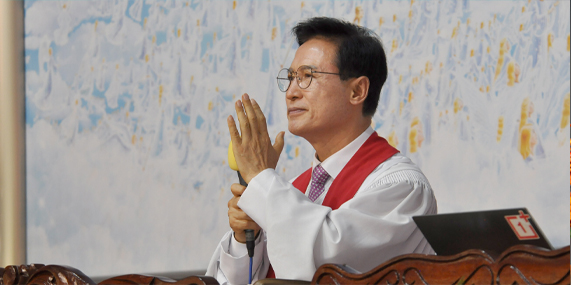
Live with Gratitude for God's Gift
Bible passage: John 7:37-39
“37. On the last and greatest day of the Feast, Jesus stood and said in a loud voice, "If anyone is thirsty, let him come to me and drink. 38. Whoever believes in me, as the Scripture has said, streams of living water will flow from within him." 39. By this he meant the Spirit, whom those who believed in him were later to receive. Up to that time the Spirit had not been given, since Jesus had not yet been glorified."
There is a saying ‘to live like flowing water’. What does this mean? It means to minimize the resistance in the flow of life’s energy. It is a way of saying not to waste energy on unnecessary things and to let life flow naturally like water.
For example, it means to understand that everyone is different and to accept people with personalities different from your own. You should not try to change or force someone to align with your preferences. You should not complain about changes in the world but accept them constructively and respond healthily.
You should listen to others rather than insisting on your opinions, and instead of pointing out flaws or doubting others, trust and respect them. Living in this way is like ‘living like flowing water’, and I think the Bible passage Philippians 4:11-12 corresponds to this idea. It says, “I am not saying this because I am in need, for I have learned to be content whatever the circumstances. I know what it is to be in need, and I know what it is to have plenty. I have learned the secret of being content in any and every situation, whether well fed or hungry, whether living in plenty or in want.” What is contentment? Contentment is a heart that is undisturbed by various external circumstances and enjoys perfect peace, feeling sufficient and satisfied from within.
However, the important thing is that contentment is not something that comes naturally. It must be learned and acquired through effort and practice. That is why Apostle Paul mentions twice in verses 11-12 that he “learned to be content.” Gratitude is the outward expression of a content heart. The Talmud says, “Before you tame your tongue to say ‘Thank you,’ do not let it say anything.” This teaches that gratitude must be learned, acquired, and practiced until one becomes proficient in it. Next Sunday will be Thanksgiving Sunday. To make Thanksgiving Sunday a bit more meaningful and filled with grace, today I will speak under the title “Live with Gratitude for God’s Gifts.” Today, we will look into the Feast of Tabernacles, one of Israel’s festivals mentioned in the Scripture, and through it, we will explore the levels of gratitude. This is because the Feast of Tabernacles in Israel corresponds to today’s Thanksgiving celebration.
1. The lowest level of gratitude is the kind of gratitude exemplified in the Feast of Ingathering.
In today’s scripture passage, we can see three levels of gratitude that we should offer to God in our lives. The festival mentioned here is one of Israel’s three major festivals, the Feast of Tabernacles. John 7:2 says, “Now the feast of the Jews, the Feast of Booths, was near.” In Deuteronomy, Israel’s three major festivals are explained. Deuteronomy 16:16 says, “Three times a year all your men must appear before the LORD your God at the place He will choose: at the Festival of Unleavened Bread, the Festival of Weeks and the Festival of Tabernacles. No one should appear before the LORD empty-handed:” The three major festivals mentioned here are the Feast of Unleavened Bread, the Feast of Weeks, and the Feast of Tabernacles. Since there are only three, it seems simple.
However, while it seems simple, it is also complex. This is because the same festival has multiple names. The Feast of Unleavened Bread can also be called the Feast of Passover, and the Feast of Weeks can also be called the Feast of Pentecost or the Feast of Harvest. The Feast of Tabernacles is also called the Feast of Ingathering. Therefore, the “last and greatest day of the festival” mentioned in today’s scripture (John 7:37) refers to the Feast of Tabernacles mentioned in verse 2, which is also called the Feast of Ingathering.
The second part of Exodus 23:16 says, “Celebrate the Festival of Ingathering at the end of the year, when you gather in your crops from the field.” The Feast of Ingathering mentioned here is another name for the Feast of Tabernacles. Why is it so confusing, with the same festival being called by different names? This is because the Old Testament festivals were originally related to agriculture, and their names were derived from agricultural practices. Looking again at Exodus 23:16, we see that the Feast of Weeks and the Feast of Ingathering are related to farming: It says, “Celebrate the Festival of Harvest with the firstfruits of the crops you sow in your field. Celebrate the Festival of Ingathering at the end of the year, when you gather in your crops from the field.”
The Feast of Weeks commemorates the harvest of the first fruits after sowing seeds, while the Feast of Ingathering is the celebration of storing harvested grain in barns and giving thanks afterward. These festivals also carry the memory of God’s grace in the past. As people reflected on God’s blessings, they gave these festivals new names to honor His grace. The Feast of Ingathering, for example, was a festival celebrated at the end of the year after the final harvest, when the grain was stored in barns. It commemorates the time when their ancestors lived in hardship in the wilderness after the Exodus and remembered how God fed and protected them.
It was thus renamed the Feast of Tabernacles. In today’s scripture (John 7:37), the terms “Feast,” “Feast of Ingathering,” and “Feast of Tabernacles” all refer to the same festival, which corresponds to today’s Thanksgiving celebration. This time, focusing on the different names for what is essentially the same Thanksgiving festival, we will explore the three levels of gratitude from a fresh perspective. If gratitude is something to be learned and practiced rather than simply produced, like a product, then we can think of gratitude as having levels, just as there are higher and lower fields of study. Even with gratitude, there can be shallow gratitude and deep gratitude, less mature gratitude and more mature gratitude. The first and lowest level of gratitude is what we call the gratitude of the Feast of Ingathering. Gratitude is the key to happiness.
However, if we fail to give thanks for the good things we receive, boast about ourselves, or become arrogant, we lose the key to unlocking the grace and blessings we have received. Acts 12:23 tells the story of King Herod's sudden death: It says, “Immediately, because Herod did not give praise to God, an angel of the Lord struck him down, and he was eaten by worms and died.” King Herod was an evil king who persecuted Israel, killed John the Baptist, and committed many wicked and cruel sins. However, the Bible states that the reason for Herod’s death was not his other evil deeds but because he did not give glory to God or offer thanks. Therefore, failing to give thanks is also considered a great sin. The gratitude of the Feast of Ingathering is a situational gratitude - a gratitude for the events or conditions that occur. It is conditional gratitude, given because God has provided conditions for thankfulness.
One day, a father and son were traveling on horseback through a forest. They were on their way to find each other, and after several miles, they finally met joyfully. The son hugged his father with great delight and said, “Father, I am so thankful to God for His grace.” Curious, the father asked why. The son replied, “On my way to find you, my horse stumbled on a tree root three times. But I didn’t get hurt at all! I am so grateful to God.” Hearing this, the father said, “That’s truly something to be thankful for. But let’s also be thankful for this: on my way to find you, my horse didn’t stumble even once. Isn’t that something to be even more thankful for?” From this conversation between the father and son, we can learn an important lesson. Today, we often call this era a time of lost gratitude. Some say they cannot give thanks because there is nothing to be thankful for.
Instead of appreciating what we have, people focus on what they lack, filling their hearts with complaints and resentment. Recovering from a severe illness is not the only thing worth being thankful for. Being healthy and not falling ill in the first place is even more reason for gratitude. Finding something lost is not the only thing worth being thankful for. Being protected from losing it in the first place is even more reason to be grateful. Instead of resenting what we don’t have, let’s be thankful for what we do have. Instead of complaining about not receiving something great, let’s be thankful for keeping what is small. Gratitude for the small things, gratitude for what we already have - this is where happiness begins.
2. The second level of gratitude, which goes beyond the first, is the kind of gratitude exemplified in the Feast of Tabernacles.
This level of gratitude does not stop at simply giving thanks for the harvest during the Feast of Ingathering. It involves remembering and being thankful for the grace God bestowed upon their ancestors - how He protected and provided for them as they crossed the Red Sea and journeyed through the wilderness. The gratitude of the Feast of Tabernacles is not about being thankful for a single event but for the grace and love God displayed throughout the process leading to that event. During the Feast of Tabernacles, the Israelites would make a pilgrimage to the temple in Jerusalem.
On their way, they would live in booths, reflecting on how God fed, clothed, and protected their ancestors in the wilderness from wild animals and foreign enemies. For us, being grateful that our church experienced no major difficulties this year and achieved success in online missions, announced plans for a new sanctuary building, and joyfully celebrated its anniversary, is an example of the gratitude of the Feast of Ingathering. Reflecting on this, I felt deeply moved by God’s overwhelming love and grace throughout the past week, prompting much gratitude. Even with the sudden passing of Bishop Myong-Ho Cheong, God stabilized the church, and despite my lack of familiarity with Kenyan culture and customs, He covered my shortcomings with abundant grace and love.
God has sustained me with the health and vigor of youth even as I age. For all of this, I am deeply grateful to God. Recognizing this is the gratitude of the Feast of Tabernacles. It is not by our wisdom or effort. Everything is the result of God’s grace and care. This applies not only to our church but also to our families. While being grateful for blessings like finding good jobs, expanding businesses, recovering from illnesses, or restoring families is valid, these are surface-level expressions of gratitude.
A deeper, more profound gratitude acknowledges, “By the grace of God, I am who I am.” A story is told of a pastor in Korea who received an email from a heretical group. The email read as follows: “In three years, we will bring you down. Of all the people we have targeted so far, none have resisted. No matter what, we will bring you down.” Initially, the pastor felt a chill and tension, even a hint of fear. But soon, the tension lifted, and the fear dissipated. He reasoned that if this group truly intended to bring him down, he would become more cautious, ensuring his words and actions were above reproach. He resolved to live more truthfully and devoutly, thinking this would not harm him but actually benefit him. Why did David fall? Was it because of Goliath?
Was it because of King Saul, who persistently sought to kill him? No, ironically, David fell not because of Goliath or Saul but because they were absent. When David committed adultery with Bathsheba and planned Uriah’s murder, he was in a period of great stability, where his power was unchallenged, and no one could oppose him. It was this complacency that led to his downfall. Our "Goliaths" are not threats to us. Even "King Sauls" are not unnecessary adversaries. These challenges can become reasons for gratitude.
This is the gratitude of the wilderness, the gratitude of the Feast of Tabernacles. Like that pastor, we should live with the assumption that someone may be trying to bring us down. With this perspective, we can stay vigilant, live devoutly, pray fervently, and walk in truth, which is the wise way to live. The Bible tells us in 1 Peter 5:8 that the enemy, the devil, prowls around like a roaring lion, seeking someone to devour. Didn’t Daniel give thanks to God even in such circumstances? Daniel 6:10 says, “Now when Daniel learned that the decree had been published, he went home to his upstairs room where the windows opened toward Jerusalem.
Three times a day he got down on his knees and prayed, giving thanks to his God, just as he had done before.” The Apostle Paul also gave thanks, even though he had a thorn in his flesh. Though he prayed three times for its removal and received no answer, he declared, “When I am weak, then I am strong,” and expressed gratitude. 2 Corinthians 12:9 says, “But He said to me, “My grace is sufficient for you, for My power is made perfect in weakness.” Therefore I will boast all the more gladly about my weaknesses, so that Christ’s power may rest on me.” This is the gratitude of the Feast of Tabernacles. Let us not remain at the level of the gratitude of the Feast of Ingathering but aspire to the higher, spiritual level of gratitude exemplified in the Feast of Tabernacles. May this Thanksgiving season be one where we offer deeper and more meaningful gratitude.
3. The third and highest level of gratitude we should reach is the kind of gratitude described in John 7:37.
The verse itself is full of grace, but understanding its background makes it even more moving. The Feast of Tabernacles lasts for a week, and during this time, two main rituals were held in the priests' courtyard for pilgrims visiting the Jerusalem temple. The first is the water-pouring ritual, known as the libation ceremony. During the Feast of Tabernacles, the high priest, priests, and pilgrims would draw water from the Pool of Siloam and pour it on the altar.
The purpose of this water-pouring ritual was to pray for the blessing of the early rains that were needed before the Feast of Tabernacles. When the procession carrying water from the Pool of Siloam entered the priests’ courtyard, the priests would blow silver trumpets and sing hymns inspired by Isaiah 12:2-3. Isaiah 12:2-3 says ““Surely God is my salvation; I will trust and not be afraid. The LORD, the LORD himself, is my strength and my defense; He has become my salvation.” With joy you will draw water from the wells of salvation.” Carrying jars of water, they would walk toward the altar, singing this song. The second ritual involved placing willow branches around the altar and reciting prayers. These willow branches were brought from the village of Motza, southwest of Jerusalem, where willows grew abundantly.
Willows were used because they wither and die quickly without water, and these branches were placed near the altar. As they looked at the willow branches, which would wither and dry without water, pilgrims would walk around them and recite the prayer from Psalm 118:25 which says, “LORD, save us! LORD, grant us success!” Through this ritual, they pleaded, “Just as the willow trees wither and die without water, so too do our lives falter without it. Please grant us Your grace, LORD.” Why did Jesus deliver His message about the rivers of living water on the last day of the Feast of Tabernacles? This was the most fitting moment to reveal who He was and how He gives life through the Holy Spirit. On the last day of the feast, Jesus stood near the altar and cried out: “If anyone is thirsty, let him come to Me and drink. He who believes in Me, as the Scripture said, ‘From his innermost being will flow rivers of living water.’”
Imagine this scene: a crowd gathered for the feast, participating in rituals, while Jesus made this profound declaration. Why did He speak such strange words at that moment? The people were devoutly performing religious rituals, but they failed to recognize the true source of living water. Jesus lamented over their ignorance. They fetched water from the Pool of Siloam, poured it on the altar, and watered the willow branches to prevent them from withering. Yet, they did not understand that this water symbolized the Holy Spirit. They were caught up in ceremonies and rituals, missing the deeper spiritual truth. Jesus’s cry was a plea for them to seek not just physical water but the living water of the Holy Spirit, which alone could transform their withered lives into vibrant ones. If we understand the heart of Jesus, we should strive to let rivers of living water flow through our church.
As I have often said, we must make our church a place where the "Upper Room of Mark" revival flows abundantly. During Daniel's prayer meetings, living water should overflow, and in every worship service, the Holy Spirit should flow freely like streams of life. In Kenya, the rainy season is bringing heavy rain. While I am concerned about our members avoiding flood damage, I also hope that the spiritual rain of the Holy Spirit will pour down on us during our prayer meetings, soaking us with His grace. The gratitude described in John 7:37 is the gratitude for the gift of the Holy Spirit. As Jesus prepared to leave this earth, He made a promise to send the Helper, the Holy Spirit, to us. The Greek word for the Holy Spirit, Parakletos, means "one who comes alongside to help."
The Holy Spirit is not distant but is by our side, holding our hands, always with us. There is a story of a heart patient preparing for surgery. The night before, a nurse visited the patient to explain the procedure: “During the surgery, your heart will be detached from your body, and your life will be sustained solely by machines. After the surgery, for six hours, you will not be able to move, see, or speak.” Hearing this, the patient grew anxious. But the nurse held the patient’s hand and reassured him: “Don’t worry. I will stay by your side, holding your hand, just as I am now. I will monitor every risk, record every occurrence, and take all necessary actions to ensure your safety.”
During the surgery, the patient felt the nurse’s warm, reassuring hand, even in his most critical and vulnerable moments. This brought him immense comfort and peace, helping him recover successfully. The most noble form of gratitude during the Feast of Tabernacles is to recognize and thank the Holy Spirit, who comes alongside us, holds our hands, and prevents our lives from withering like the willow branches. Just as Jesus proclaimed, “Whoever believes in Me, rivers of living water will flow from within them,” may the living water of the Holy Spirit overflow in your hearts and become a river in your lives. May this living water wash away all worries and anxieties, leaving behind only gratitude in this season of Thanksgiving.
4. Realize that life is a gift from God and live every moment with gratitude.
When we accept Jesus Christ as our Savior and receive the Holy Spirit as a gift, we must recognize that our entire life is God’s gift. Ecclesiastes is like a treatise on life, discussing what life is all about. King Solomon, the author of Ecclesiastes, initially saw life as meaningless and vain, but later came to understand it properly and said: Ecclesiastes 3:12-13, “I know that there is nothing better for people than to be happy and to do good while they live. That each of them may eat and drink, and find satisfaction in all their toil—this is the gift of God.” Solomon realized that during a person’s life, there is nothing better than to do good, to eat and drink, and to understand that all of this - living itself - is a gift from God. Indeed, we must acknowledge that our entire life is a gift from God. God desires for us to enjoy life happily and to use it for His glory.
Though life may feel meaningless, mysterious, and fleeting like a vapor, we must cherish it as God’s gift, treasure it, and live joyfully. This is the “life assignment” God has given to all humanity. Just as a teacher assigns homework at school, which we complete and submit the next day for inspection, God has given us a life assignment to work on until the day we die. And what is this assignment from God? It is to cherish life as the gift it is, to live with joy and gratitude, and to bring delight to God. A pastor who had immigrated to Canada and ministered there passed away at the age of 85. The day before his passing, his family gathered around his bedside to hold a farewell worship service. After the service, his children asked, “Father, do you have any last words for us?” Using his last ounce of strength, the pastor said, “I have no more desires on this earth. Lord, I am happy.”
He was a person who lived life as the gift from God it was. We too should strive to live such a life, seeing it as God’s precious gift. Beloved congregation, to finish life and confess, “Lord, I am happy and thankful,” is not something anyone can do easily. With the resources God has given us in life, let us pray, “God, let my life be a giftlike life You have given me,” and as we work on this life assignment with diligence and effort, may we all reach the end of our lives able to say, like that pastor, “Lord, I am happy.” To live life as the gift from God it is, we must live every day and every moment with gratitude. There is a famous phrase, “Carpe Diem.” This phrase, first used by the Roman poet Horace in his works, means “Seize the day” or “Be faithful to the present moment you are living.” It urges us to grasp this moment and cherish it. Horace wrote this to comfort Romans who had experienced terrible wars and were filled with fear and sorrow, encouraging them to cherish each day.
In a similarly bleak society, we must revive a movement of gratitude. To live life as the gift God has given us, we must restore the practice of gratitude. Psalm 118:28-29 says, “You are my God, and I will praise You; you are my God, and I will exalt You. Give thanks to the Lord, for He is good; His love endures forever.” Even if you go to bed upset or hurt by something that happened the day before, the next day is a new day. As soon as you open your eyes, declare this wonderful word and step forward with gratitude. Gratitude is a discipline. Are you keeping a Daniel 21 gratitude journal? In a previous sermon, I shared the story of the “miracle of 100 thanksgivings.”
I encouraged you to write down 21 things you are thankful for each day in your gratitude journal, and to do so for 100 days without missing a single day. Do you remember? If we calculate 100 days from when we started, the end will be around January 10 of next year. By then, if you will have written 21 things you are grateful for each day without missing a day, and submit your journal, we will select one person to receive a ticket to Korea for next year’s summer retreat at the headquarters church. Do you remember? Raise your hand if you have been writing! The fire of gratitude must ignite. In the “Upper Room of Mark” that we pursue, the fire of gratitude surely burns, because where the Holy Spirit is abundant, gratitude also overflows.
A pastor’s wife in one church was diagnosed with stomach cancer and fell into despair and resignation. Believing her suffering came from the hardships of starting a church, resentment towards her husband and God began to grow. At this time, the pastor bought her a notebook and told her to write down everything she could find to be thankful for. She retorted, “What is there to be thankful for in this situation?” and refused to write. One day, however, she came across a hymn called “The Song of Gratitude” written by a seminary professor. The lyrics went like as follows: Grateful for this, grateful nonetheless, Grateful despite, grateful therefore, Grateful even so, just grateful, Grateful whether it happens or not, Grateful come what may, always grateful. Reading these lyrics, the pastor’s wife began to write in the notebook, starting with very ordinary and small things.
Day after day, she continued, and as she did, her pain gradually diminished, and strength returned to her legs. When she went to the hospital, the doctors were amazed - the cancer cells had disappeared. Regardless of the circumstances, let us say, “God, I want this day, too, to be a gift from You.” Conclusion Without a key, a storage room cannot be opened. Conversely, with a key, even a firmly locked storage room can be unlocked. Chrysostom, the great preacher known as the "Golden Mouth," once said this about gratitude: "One who is not stingy with gratitude holds the key to blessings in their hand." There was a mother who had two sons - one sold umbrellas, and the other sold slippers. Unfortunately, she could not find happiness or gratitude in her daily life. On rainy days, the umbrella business thrived, but the slipper business suffered, making her worry about her second son and unable to be thankful.
On sunny days, the slipper business thrived, but the umbrella business suffered, making her worry about her first son and again unable to be thankful. If gratitude is based solely on conditions, one will never truly be thankful. We must become people of unconditional gratitude, transcending circumstances to be grateful regardless of whether it rains or shines. To live the beautiful, gift-like life God has given us, we must move beyond the lowest level of gratitude, the gratitude of the Feast of Ingathering.
We must express the gratitude of the Feast of Tabernacles, acknowledging God’s grace and power, and ultimately live in high-level gratitude by thanking the Holy Spirit, our Helper, who is always by our side. By living this way, may your life truly become the gift from God that it is meant to be. - END -